
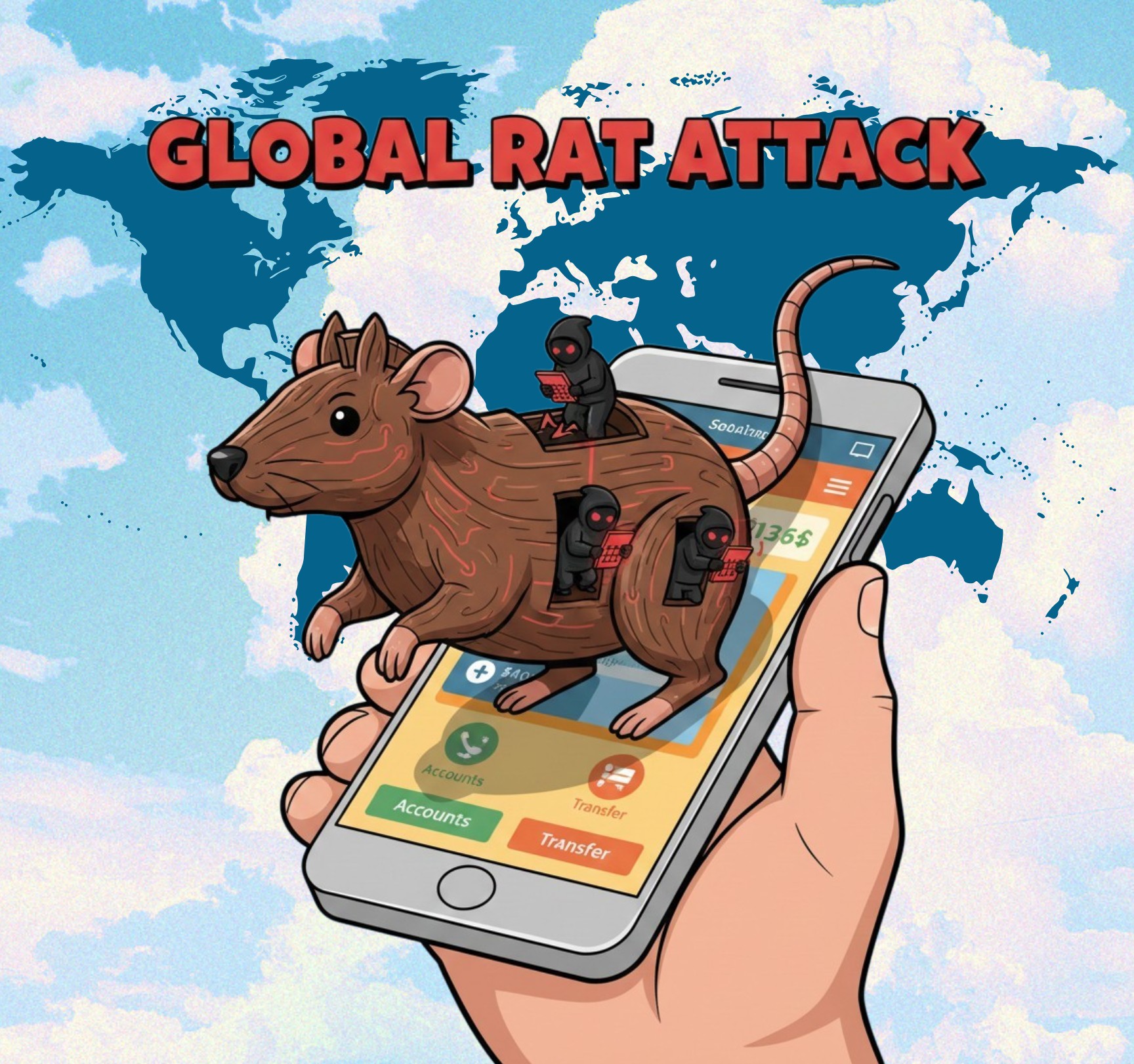
 Remote Access Trojans, commonly referred to as RATs, have evolved into one of the most disruptive and least geographically constrained threats facing the global financial ecosystem. While recent reporting from South African institutions highlights a sharp regional escalation in these attacks, the underlying infrastructure, distribution models, and operational mechanics make it clear that RAT-driven fraud is not a localized issue. This is a global problem operating without borders, jurisdictions, or traditional constraints.
Emerging Global Trends
Threat intelligence collected by international cybersecurity firms shows a sustained rise in mobile-based RAT activity across Europe, South America, and Southeast Asia. Malware families such as Albiriox demonstrate how far these tools have progressed. By abusing accessibility services, these trojans enable full device control, allowing attackers to observe screens, capture keystrokes, intercept credentials, and authorize transactions in real time.
What makes this evolution particularly dangerous is the widespread adoption of Malware-as-a-Service distribution. Through MaaS platforms, sophisticated RAT frameworks are packaged, marketed, and sold to low-skill criminals worldwide. This has removed the technical barrier to entry, enabling actors with minimal expertise to launch high-impact attacks against banking and cryptocurrency users in multiple regions simultaneously.
In Spain and Italy, researchers have recently identified the Klopatra trojan, a hybrid strain that operates both as a Remote Access Trojan and as dedicated banking malware. These infections are commonly delivered through seemingly harmless dropper applications hosted on third-party app stores or shared via platforms such as Discord. By separating the delivery mechanism from the malicious payload, these campaigns are able to evade many static detection controls used by conventional antivirus products.
Insights From South African Reports
Findings published by the South African Banking Risk Information Centre offer a concentrated snapshot of a much broader global trend. SABRIC’s 2025 assessment revealed that reported digital banking fraud incidents in South Africa nearly doubled within a single calendar year, mirroring patterns seen in other mobile-first markets.
Financial institutions operating in the region highlighted several critical observations. Fraud specialists from banks such as TymeBank have emphasized that the core risk is no longer credential theft alone. Once a criminal gains control of a customer’s device, the fraud occurs from within a trusted environment. From the bank’s perspective, the transaction originates from the legitimate smartphone, using valid applications, locations, and behavioral patterns.
Supporting this view, data from the National Financial Ombud Scheme showed a 73 percent increase in digital banking fraud complaints during the first half of 2025 compared to the same period the previous year. The economic impact is equally severe. Gross losses attributed to digital fraud reached approximately R1.9 billion in 2024, with banking applications responsible for roughly 65 percent of recorded incidents.
A Borderless Mechanism
The global reach of RAT-based fraud is driven by universal weaknesses in mobile operating systems and user behavior rather than country-specific flaws. Attackers routinely exploit fear, urgency, or authority to persuade victims to install malicious APK files distributed through SMS phishing links or messaging platforms such as WhatsApp.
Once a trojan is active, physical distance becomes meaningless. A fraudster operating on one continent can observe One-Time Passwords, approve transactions, and manipulate applications in real time on a device located thousands of kilometers away. Traditional indicators such as IP address or device fingerprinting offer limited protection when the attack is executed from within the victim’s own phone.
As a result, modern defensive strategies are shifting away from static authentication controls toward behavioural analytics. Financial institutions are increasingly deploying systems that monitor for anomalies such as simultaneous touch inputs, remote interaction patterns, or background screen streaming activity. Because RAT variants evolve rapidly and are redeployed across regions within days, international collaboration and real-time threat intelligence sharing are becoming essential components in protecting the global mobile-first economy.
- Log in to post comments