
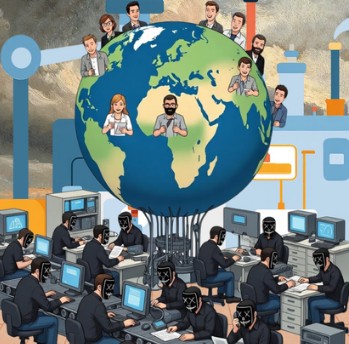
 For years, online scams were dismissed as small time fraud, few emails, a few fake profiles and a few unlucky victims. What exists today is a global scam economy structured, financed, technologically assisted, and increasingly protected by weak regulation, corruption, and geopolitical blind spots.
While lone wolves still exist, this has become less about individual criminals and more about highly structured systems.
FROM HUSTLERS TO INDUSTRIES
Early online scams were informal and opportunistic. One person wrote the message, contacted the victim, and handled the money. Today, scams operate like businesses; roles are divided, processes are standardized and performance is tracked.
In the most advanced operations, one team writes scripts, another runs social engineering, another handles technical infrastructure, another launders funds, and another recruits money mules in Western countries. The people speaking to victims often have no access to the money and no control over the broader operation; this division of labour is what allows scams to scale.
THE RISE OF SCAM HUBS
Scam activity does not spread evenly across the world. It concentrates where conditions allow it to grow. Southeast Asia has become the most industrialized scam region on the planet. In parts of Myanmar, Cambodia, Laos, and the Philippines, scam compounds operate openly. Workers are trafficked or coerced, targets are assigned, quotas are enforced, and failure is punished.
South Asia has professionalized call center fraud and business email compromise, these operations often hide behind legitimate outsourcing firms making enforcement difficult.
Eastern Europe dominates malware, ransomware, and financial system intrusion with technically sophisticated and highly disciplined criminal organizations.
West Africa has evolved from solo actors into layered teams specializing in social engineering, crypto laundering, and mule recruitment. This is the home of most Romance, recovery and impersonation type scams with groups like the Sakawa boys of Ghana and the Yahoo boys of Nigeria.
EAST AFRICA ENTERS THE SCAM ECONOMY
East Africa, long associated with maritime piracy and coastal smuggling, is transitioning into digital fraud, as the risk profile of traditional piracy increases. Expanded naval patrols, private security on commercial vessels, and international enforcement have made marine hijacking far more dangerous and less profitable than it once was.
Criminal networks adapt when pressure is applied. In East Africa, this adaptation is moving from the sea to the screen; groups once specialized in piracy logistics, ransom negotiation, and cross border laundering already possess the core competencies required for online scams. They understand intimidation, deception, operational security, and profit sharing. The shift requires less equipment, fewer personnel, and significantly lower physical risk.
Unlike the West African Sakawa and Yahoo Boys, East African scam operations are still decentralized. They rely on small teams, rented office space, and residential compounds rather than large scale facilities. However, the trajectory is familiar, informal operations consolidate, roles specialize and financing becomes structured.
Coastal cities and trade corridors with existing smuggling infrastructure have become early footholds. Reliable internet connectivity, expanding mobile money systems, and access to diaspora networks provide the tools needed to operate internationally while remaining locally insulated. The scam typologies emerging from the region reflect this background as extortion, romance manipulation, fake shipping disputes, advance fee fraud, and investment lures dominate early activity. These scams emphasize psychological pressure and prolonged engagement rather than brute force of piracy or the technical sophistication of existing scam networks.
As enforcement continues to squeeze traditional piracy, the economic logic favors digital crime; online scams offer reach without borders, revenue without hijackings, and deniability without hostages.
It is important to note, East Africa is not replacing existing scam hubs, it is joining them. The global scam economy does not expand randomly. It expands where risk falls and opportunity rises.
AI AS A FORCE MULTIPLIER
Artificial intelligence has accelerated the transformation of the Scam Industry at a speed law enforcement and regulators did not anticipate. AI tools now generate fluent scripts in dozens of languages, calibrated to local slang, cultural norms, and emotional triggers. Scammers no longer rely on broken grammar or copy pasted templates; messages are tested, refined, and optimized at scale.
Voice cloning allows criminals to impersonate family members, executives, and authority figures with disturbing accuracy. A single recorded voicemail is often enough to recreate a voice capable of live conversation which has fueled the explosion of emergency scams, executive fraud, and extortion calls.
Chat automation has eliminated the need for constant human interaction. AI driven chat systems can manage thousands of conversations simultaneously, escalating only high value targets to human operators. Victims believe they are speaking to a real person throughout the entire interaction.
Behavioural analysis tools track hesitation, emotional language, response time, and compliance signals. AI flags victims who are fearful, isolated, elderly, grieving, or financially stressed. These victims are prioritized, while resistant targets are quietly abandoned, resulting in more efficient victimization.
INFRASTRUCTURE BEHIND THE SCAMS
Industrial scams rely on physical and digital infrastructure such as Data centers, proxy networks, SIM farms, crypto exchanges, payment processors, and shell companies. Many of these services are legal, regulated, or semi regulated businesses, some of which are abused rather than built explicitly for crime.
Some scam hubs are located near new technology parks, free trade zones, or special economic areas where oversight is intentionally relaxed to attract foreign investment. In these regions, high bandwidth connectivity and cheap power make large scale operations viable.
In certain jurisdictions, officials benefit indirectly through bribes, kickbacks, or local economic activity. Workers rent apartments, food is purchased locally, transport is hired and entire neighbourhoods become financially dependent on scam activity. This eco omic reality creates a quiet incentive for local officials to look away.
FINANCIAL LAUNDERING AT SCALE
The money trail has become more sophisticated than most law enforcement systems can track; funds move through crypto wallets, prepaid cards, money mule networks, online gambling platforms, fake investment portals, and cross border payment apps with each step designed to fragment the trail.
Mule recruitment is now a specialized industry where western nationals are recruited through fake job postings, romance scams, or social media offers. Mules believe they are processing payments or testing systems when in reality, they are absorbing legal risk for criminal networks.
LAW ENFORCEMENT LAG AND JURISDICTION GAPS
Most policing systems are built for local crime. Scam networks are transnational by design. A victim in Canada may be targeted by a call routed through three countries, operated by trafficked workers in a fourth, using infrastructure hosted in a fifth, with money laundered through six or more. Each jurisdiction sees only a fragment of the crime and often no single agency sees the full picture.
When arrests occur, they often target low level operators, mules, or coerced workers and the financial architects and infrastructure controllers remain insulated. Extradition barriers, corruption, limited cyber expertise, and political sensitivity further weaken enforcement.
WHY THE SCAM INDUSTRY WILL CONTINUE TO GROW
Scams persist because they work, they:
- Deliver high returns with relatively low risk.
- Exploit emotional vulnerabilities rather than technical flaws.
- Adapt faster than regulation.
- Benefit from global inequality, weak labour protections, and uneven digital literacy.
As AI becomes cheaper and more accessible, the barrier to entry will continue to fall while the scale of harm increases. This is not a temporary crime wave, i is a mature criminal economy embedded within the global digital system.
Until governments treat scams as organized economic crime rather than individual fraud incidents, the industrialization of deception will continue to accelerate. This is no longer a nuisance problem, it is an industry.
- Log in to post comments