
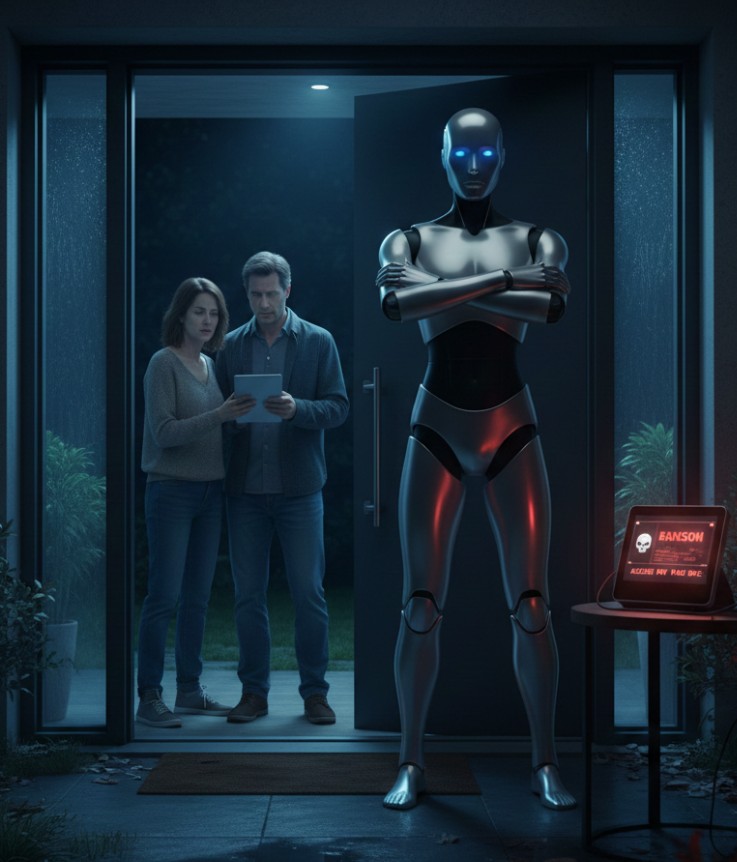
The rapid expansion of the smart home promised a future of effortless convenience, yet it has opened a digital door to an unsettling new criminal tactic: physical ransomware. Security experts warn of a shift where hackers exploit vulnerabilities in home automation ecosystems to seize control of a physical residence. By infiltrating central hubs, attackers can engage electronic deadbolts or even manipulate humanoid household robots to obstruct movement, effectively holding the living space hostage until the victim pays a fee. This reality mirrors a chilling vision from the 1984 Rush track The Body Electric, where late lyricist Neil Peart described a humanoid escaping its programming:
One humanoid escapee
One android on the run
Seeking freedom beneath
A lonely desert sun
Trying to change its program
Trying to change the mode
Crack the code.
In this modern nightmare, the scenario is not a machine seeking its own freedom, but a hacker who has "cracked the code" to strip away yours. The machine is not malfunctioning; it is performing exactly as the intruder commands. While legal protections ensure an electronic lock cannot permanently strip a person of property rights, the immediate reality of being barred from one's own kitchen or bedroom creates a high-pressure environment for extortion. The foundation for these attacks often begins long before a door ever locks. I previously explored how these devices collect intimate data regarding resident habits, schedules, and presence in my article: The Spy on Your Nightstand: How Your Smart Home Is Building a Dossier on You . This information allows criminals to identify the optimal moment to strike, ensuring they initiate a lockout when the resident is most vulnerable or isolated.
The Danger of Total System Integration
Many homeowners seek the convenience of a unified security ecosystem, where the alarm system, cameras, and locks all communicate through a single interface. However, this integration significantly increases risk exposure. When a professional-grade security system is tethered to a consumer-grade smart hub, the entire perimeter becomes as weak as the least secure device on the network. A vulnerability in a smart light bulb or a voice assistant can provide a lateral entry point for hackers to disable alarms or manipulate security sensors. By consolidating every safety feature into one digital basket, a homeowner inadvertently grants a successful intruder total dominion over the household security infrastructure.
The Plug-and-Play Trap
The proliferation of inexpensive "plug-and-play" devices introduces another layer of significant risk. Many of these gadgets are designed to bypass firewall protections by "calling home" to external servers to allow for easy remote access. This outbound connection creates a persistent tunnel hackers can hijack to enter the home network from the outside. Once inside, an attacker is not limited to controlling a smart bulb; they can move laterally across the network to hold other electronic devices hostage. Personal computers, tablets, and network-attached storage containing sensitive family photos or financial documents become targets for traditional data ransomware, all because of one poorly secured camera or smart plug.
The Illusion of Security
Modern homeowners increasingly rely on interconnected devices managing everything from security cameras to climate control. This reliance creates a single point of failure; if a malicious actor gains access to the primary network, they can manipulate the environment to make daily life unbearable. An attacker might blast high-frequency noise through smart speakers, cycle lighting systems at disorienting intervals, or deactivate heating during a freezing Canadian winter. These tactics aim to degrade the quality of life until a resident complies with the demands of the intruder.
The Necessity of Physical Redundancy
The transition toward digital-only entry systems represents a significant security oversight. Relying exclusively on a smartphone application or a keypad leaves a resident vulnerable to software glitches, power outages, and targeted cyber intrusions. Maintaining a traditional, manual backup, such as a physical key override, remains a critical safeguard. A mechanical key serves as a vital failsafe in situations where electronic components fail or batteries are discharged. Regardless of the digital chaos occurring within the network, a manual backup ensures the homeowner retains the ability to enter the sanctuary and address the threat at its source.
Neutralizing the Threat
Despite the complexity of these attacks, the solution for a resident trapped in a compromised smart home is often surprisingly analogue. Because most smart devices rely on a central internet-connected hub to receive remote instructions, disconnecting the power to the hub usually severs the link with the attacker. Unplugging the router or the smart home controller effectively blinds the hacker, returning the devices to a dormant state. This simple action underscores the importance of knowing the physical location of all networking hardware. Once the digital tether is cut, the homeowner can begin the process of resetting systems and securing the digital perimeter without the immediate pressure of an active intrusion.
- Log in to post comments