
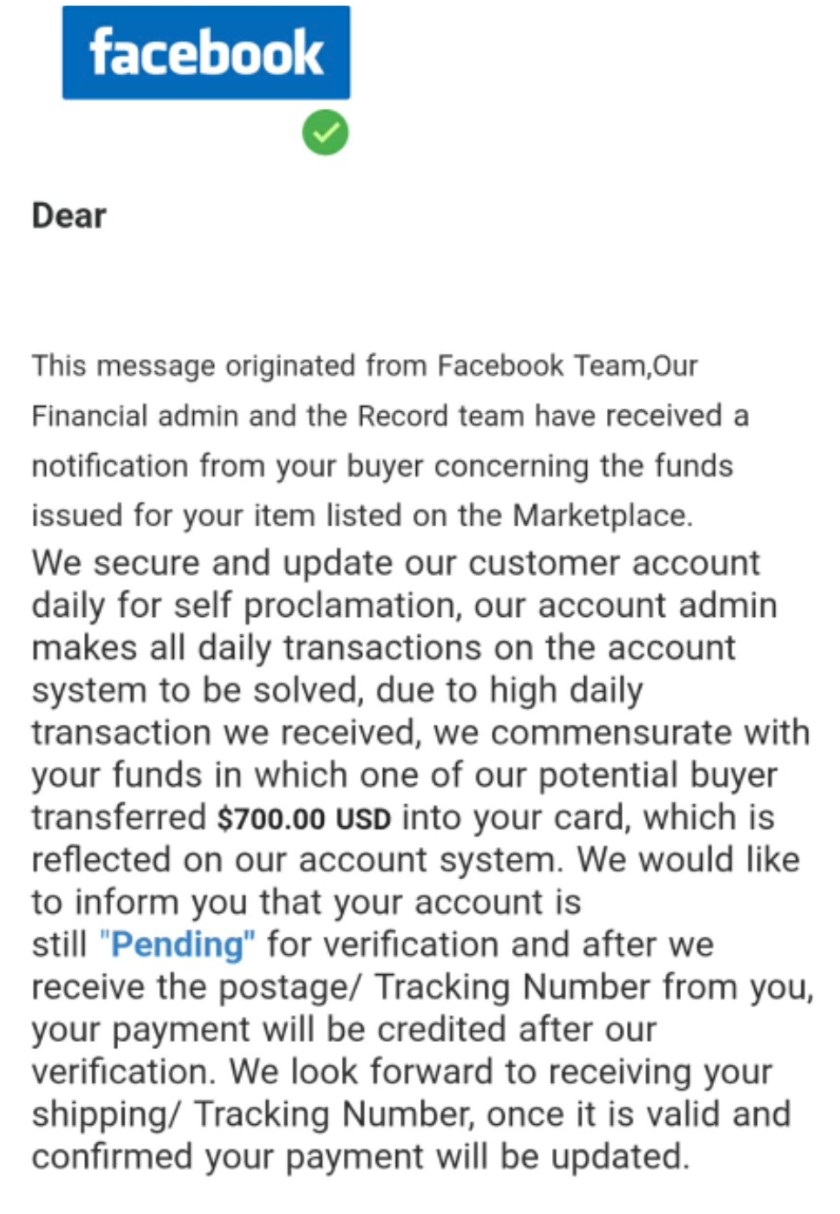
 A Facebook follower recently brought this Facebook Marketplace scam to my attention, and it highlights how far criminals will go to exploit the trust people place in familiar platforms. The individual received what looked like a formal notice from Facebook claiming a buyer had already paid several hundred dollars for an item and the money was sitting in a pending state. The message insisted the account would only be updated after the seller shipped the item and provided a tracking number. On the surface it appears to be about shipping, but the real objective is much more dangerous.
🪤THE TRACKING STORY IS ONLY A BAITING DEVICE
This scam is not truly about obtaining a tracking number or even securing the product itself. The tracking story is a prop designed to keep the victim engaged while the criminals work toward their real goals, which are to make the victim click a malicious link or hand over sensitive financial information. These messages often include links claiming to lead to a Facebook payment portal or a courier site, but in reality they can be phishing pages designed to steal login credentials, bank details, or card numbers. In some cases a link may silently download malware allowing the attacker to spy on the device, capture keystrokes, or intercept future logins to banking and shopping apps. The fake “verification” process may also ask the victim to upload photos of identification, front and back images of payment cards, or online banking screenshots, all of which can be used to empty accounts or open new lines of credit in the victim name.
⌛THE THREATS, ACCUSATIONS, AND PSYCHOLOGICAL PRESSURE
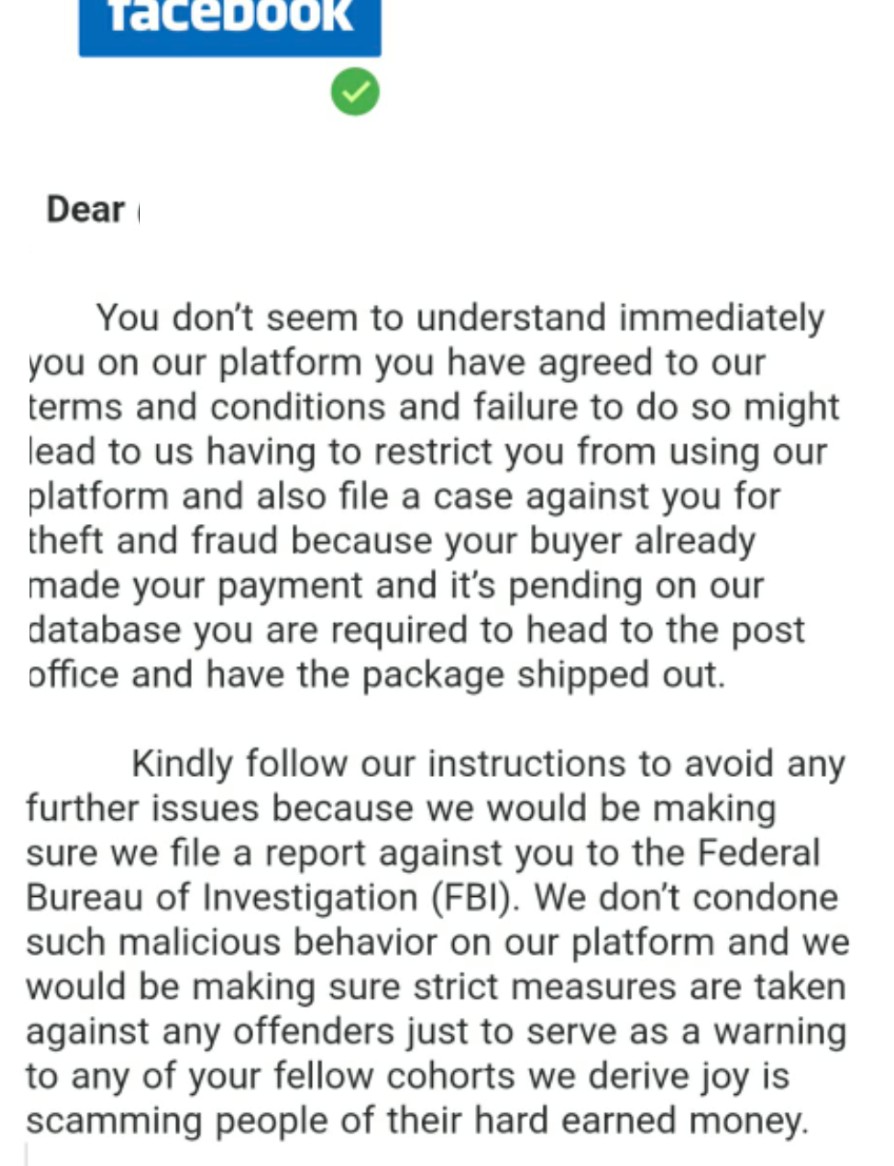 The follow up message escalates the pressure by accusing the target of theft, threatening to restrict platform access, and even invoking the Federal Bureau of Investigation. This style of overblown language is not standard practice for any legitimate company, but it is a common tool for organised scam groups specialising in advance fee fraud and fake escrow schemes. Their goal is to use threats and urgency to frighten the victim into complying quickly, before there is time to verify anything through the official app or by contacting support directly. These crews have used similar tactics for years on platforms like Craigslist and other classified sites, inventing pending payments, legal departments, and urgent deadlines to push people toward unsafe links and fraudulent payment forms. The product being sold is almost irrelevant to them; what matters is the opportunity to harvest account access, personal data, and banking credentials.
💸THE REAL OBJECTIVE IS DATA AND FINANCIAL CONTROL
These operations are designed around surveillance and monetisation of the victim identity. Once criminals gain access to bank accounts or mobile payment platforms, they can drain balances, redirect deposits, or even change account recovery details so the victim cannot immediately lock them out. Several organised rings have used these stolen data bundles to open new phone numbers, apply for storefront credit accounts, and transfer funds under the victim identity. It mirrors what has been historically seen from West African advance fee crews and from digital deployments of Sakawa style fraud structures, where psychological pressure, identity harvesting, and legal posturing are combined into one staged interaction.
🦠THE MALWARE DELIVERY MECHANISM IS OFTEN HIDDEN IN THE PROCESS
Many victims underestimate how malware is not always an obvious download. In these scams the malicious payload can come in several forms. A tracking link can redirect through multiple shortened addresses and trigger an automatic file retrieval disguised as a shipping label. Some versions instruct the victim to install a so called seller verification plug-in or browser extension, which is actually spyware. Others deliver malware through a PDF invoice containing embedded scripts, flipping a trusted document format into a silent infection channel. Once installed, these tools function as credential collectors, clipboard monitors for banking details, and even remote access modules. The attacker can view device contents, intercept multifactor authentication codes, and insert themselves into future payments or transfers.
✋THE PROPER RESPONSE AND HOW PEOPLE CAN PROTECT THEMSELVES
The safest response to a message like this is to ignore any instructions and verify everything through the platform itself. If a buyer claims to have paid, the seller should check their Marketplace payouts and their bank or payment app rather than trusting a screenshot or grandiose claim. Any link requesting a re login, asks for full card details, or instructs the user to “confirm” their bank account to release funds should be treated as hostile. Typing the platform address manually into a browser, enabling multifactor authentication, and using unique passwords for each site make it much harder for these phishing based scams to succeed. Sharing examples like this helps others understand that the real danger is not just losing an item in the mail, but handing criminals the keys to their entire financial life and I appreciate to information the follower sent me, together we can make it hard for scammers to succeed
ADDITIONAL CONTEXT MANY VICTIMS MISS
Many people assume because the scam arrives on what appears to be a company branded email, it must have come from Facebook itself. Criminals spoof headers, copy support wording, and often reuse identical formatting from real support messages. They sometimes even create fake dispute case numbers to make the sender appear official. People also fall for it because they already emotionally committed to selling their item, so the claim of a payment being held feels believable. Once that emotional hook sets in, the pressure tactics have more effect. It is critical to slow down, log into the official platform separately, and never trust what is delivered through a message thread controlled by a stranger.
- Log in to post comments